
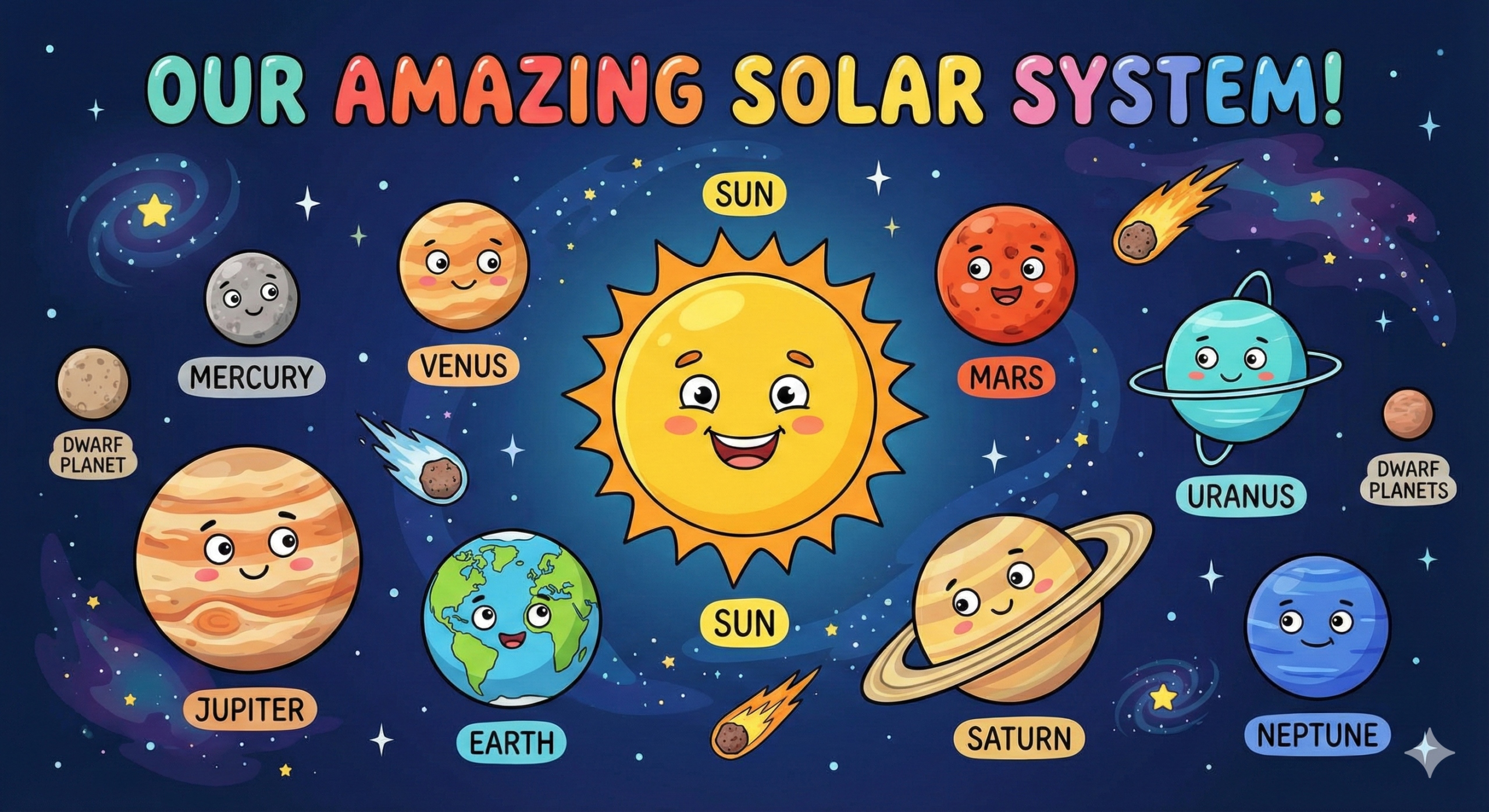
The Solar System is our cosmic home — a huge space dominated by the Sun and everything that moves around it. It includes planets, dwarf planets, moons, asteroids, comets, dust, gases, and millions of tiny objects that orbit due to the Sun’s strong gravitational pull.
What is the Solar System?
- The Solar System consists of the Sun at its center and all the objects that revolve around it.
- Everything moves in fixed paths called orbits.
- The Sun contains nearly 99.8% of the mass of the entire Solar System — that’s why its gravity is strong enough to control everything around it.
We live on a planet called Earth, which is the third planet from the Sun. Earth orbits the Sun just like all other planets, but it is uniquely suited for life because:
- It has water
- It has oxygen
- It has a protective atmosphere
- It has the right temperature range
How Big Is the Solar System?
The Solar System is unimaginably large — distances between planets are so vast that scientists use a special measurement called the Astronomical Unit (AU).
- 1 AU = the distance between Earth and the Sun = 150 million kilometers
The average distance between the Earth and the Sun is approximately 150 million kilometers (93 million miles).
The distance changes because Earth’s orbit is slightly oval. At its closest point (perihelion), Earth is about 147 million km away, and at its farthest point (aphelion), it is about 152 million km away.
So What Is The Solar System Made Of?
- The Sun — a giant ball of hot gases and the main source of heat and light
- Eight planets — Mercury to Neptune
- Moons — natural satellites orbiting planets
- Asteroids — rocky objects mostly found between Mars & Jupiter
- Comets — icy objects with glowing tails that appear when close to the Sun
- Meteoroids & meteors — small rocks that sometimes enter Earth’s atmosphere
- Dwarf planets — such as Pluto, Ceres, Haumea, Makemake, Eris
Why Does Everything Orbit the Sun?
Because of gravity — the Sun’s gravity acts like an invisible force pulling planets toward it.
Planets stay in motion because of their speed, and are kept from flying away into space by the Sun’s gravitational pull.
Whispers From The Universe
- Earth takes 365 and 1/4th days to go around the Sun.
- Jupiter is the largest planet.
- Mercury is the closest planet to the Sun.
- Neptune is the farthest planet from the Sun.
The Sun is so huge that more than 1 million Earths could fit inside it.