
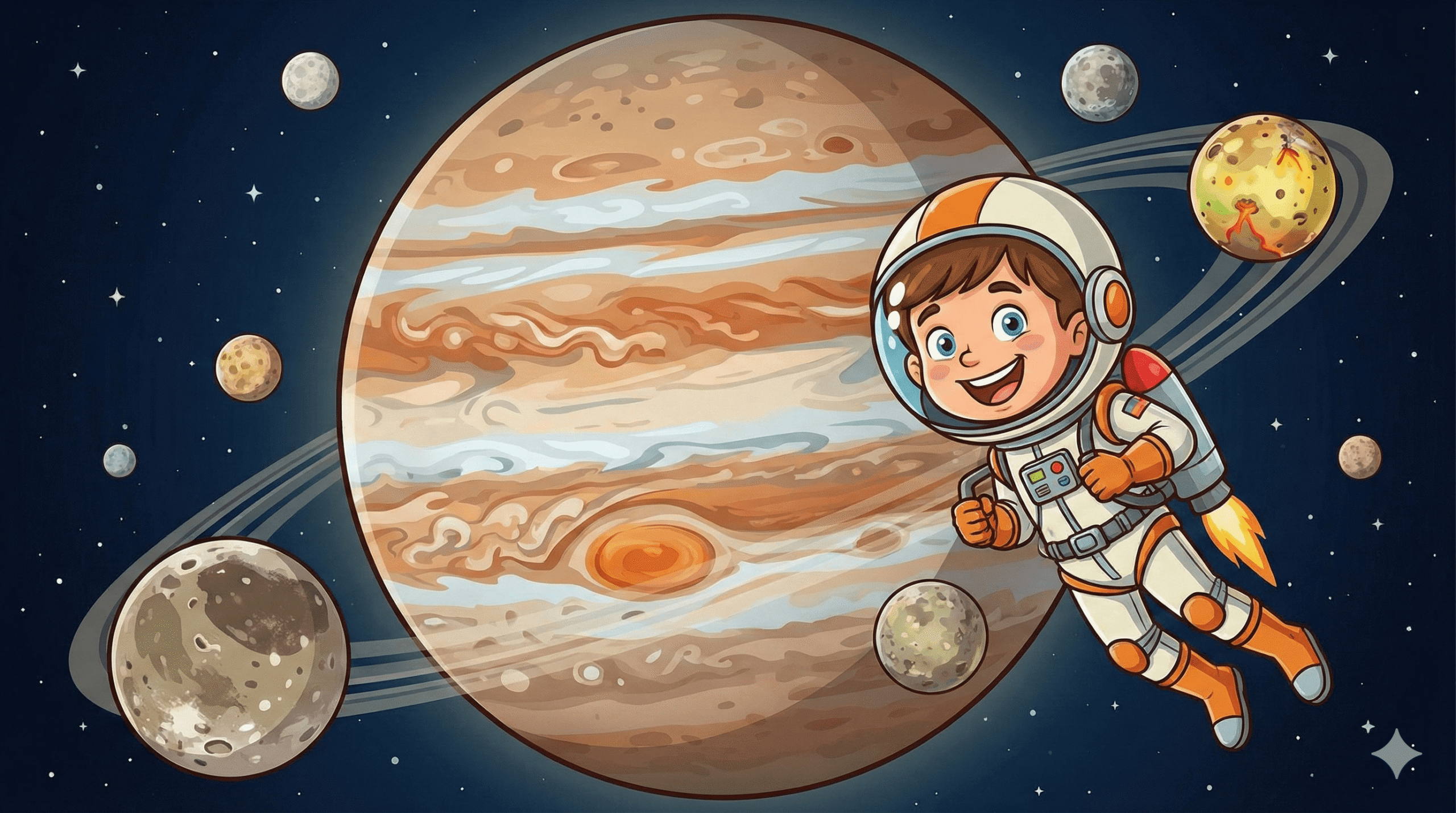
Amongst all the planets of the solar system, Jupiter is my second favourite. Earth is my favourite one, of course!! Let’s see some interesting facts about this very planet.
1. Jupiter Is the Biggest Planet of All
Jupiter is the largest planet in our solar system. It is so huge that more than 1,300 Earths could fit inside it!
Even if you added up all the other planets together, Jupiter would still be bigger than them all combined. To visualise its size, imagine Earth as a grape; Jupiter would be the size of a basketball.
2. Jupiter Is a Gas Giant – It Has No Ground!
Jupiter is made mostly of hydrogen and helium gases, just like the Sun. This means you cannot stand on Jupiter like you can on Earth.
If you tried to land a spaceship there, you would just sink deeper and deeper into the thick clouds until the crushing pressure destroyed your ship.
3. The Great Red Spot Is a Giant Storm
Jupiter has a famous storm known as the Great Red Spot or GRS. It is a massive, swirling storm that has been raging for over 300 years! The storm is so big that Earth could fit inside it.
It is made of Jupiter’s typical atmospheric gases (hydrogen, helium) with higher, red-tinted clouds.
Winds inside this storm blow at speeds of up to 270 miles per hour (432 km/h)—much faster than the strongest hurricanes on Earth. Yikes!
4. Jupiter Has The Shortest Day And A Loooong Year
A day on Jupiter is very short. It spins extremely fast and completes one rotation in just about 10 hours. This rapid spinning makes Jupiter look slightly flattened at the top and bottom.
While Jupiter’s days are short, its year is very long. Jupiter takes 11.8 Earth Years to go around the Sun once because it is so far away from the Sun.
That means if you were 10 years old on Earth, you wouldn’t even be 1 year old on Jupiter yet!
5. Jupiter Has Clouds Of Ammonia
The beautiful stripes and swirls you see on Jupiter are actually cold, windy clouds of ammonia and water. The colours come from different chemicals in the atmosphere.
The dark stripes are referred to as “belts,” while the light ones are called “zones.” They flow in opposite directions, creating the storms and turbulence we see.
6. Jupiter Has Many Moons
Jupiter has 95 known moons, the most of any planet!
Four of them—Io, Europa, Ganymede, and Callisto—are very large and are called the Galilean moons, named after the scientist Galileo Galilei.
7. Ganymede Is Bigger Than Mercury
One of Jupiter’s moons, Ganymede, is the largest moon in the entire solar system. It is even bigger than the planet Mercury, though it is still called a moon because it orbits Jupiter.
Some scientists say that it contains an underground saltwater ocean that may contain more water than there is on the surface of the Earth!
8. Jupiter Has Faint Rings
Jupiter does have rings, but they are thin and hard to see. Unlike Saturn’s awesomely bright rings, Jupiter’s rings are made mostly of dust from its moons.
They were discovered by the Voyager 1 spacecraft in 1979.
9. Jupiter Has the Strongest Gravity
Jupiter’s gravity is incredibly powerful. It pulls in asteroids and comets, acting like a giant space shield that helps protect inner planets like Earth from many space rocks.
Because of this, astronomers sometimes call Jupiter the “Vacuum Cleaner of the Solar System.”
10. Jupiter Has a Powerful Magnetic Field
Jupiter has the strongest magnetic field of any planet in the solar system. It is so strong that it creates intense radiation belts and even causes bright auroras near its poles, much stronger than Earth’s northern lights.